- Infrared Sauna Las Vegas | Cold Plunge & Cryotherapy

Recovery session scheduling is the deliberate practice of placing rest and restoration work into your weekly training plan at specific times, not just when you feel tired. Athletes and fitness-focused individuals who treat recovery as a planned training component consistently outperform those who treat it as optional downtime. The research is clear: most people need 2–3 recovery days weekly, with beginners starting at 1–2 days. Knowing how to schedule recovery sessions correctly is what separates steady progress from frustrating plateaus, especially in a high-energy city like Las Vegas where training intensity and lifestyle stress often run high together.
Recovery frequency depends directly on how hard and how often you train. The general rule is straightforward: 1 hour of recovery for every 4 hours of intense training. That ratio gives you a concrete starting point instead of guessing.
Here is how to apply it by training level:
Session length matters too. Focused recovery appointments run 15–30 minutes, while comprehensive routines that include movement, breathing work, and mobility can run 45–60 minutes. Shorter is not always worse. A 20-minute targeted session done consistently beats a 60-minute session done once a month.
Timing within the week also follows muscle biology. Small muscles like forearms and calves recover in 24–48 hours. Large muscle groups like the glutes, hamstrings, and back need 48–72 hours to reach mid-point recovery. That mid-point is the ideal window to schedule your next training session for that muscle group.
Pro Tip: Place your recovery day the day after your most demanding training session, not two days later. That is when your body needs support most.
Recovery sessions are not all the same. The type you choose changes how long it takes, how your body responds, and how it fits into your week.
| Recovery Type | Duration | Intensity | Best Scheduled |
|---|---|---|---|
| Active recovery (cycling, walking) | 20–30 min | 40–50% max HR | Day after intense training |
| Stretching and mobility work | 15–30 min | Very low | Any recovery day |
| Yoga or breathwork | 30–45 min | Low | Midweek or rest days |
| Infrared sauna or red light therapy | 20–40 min | Passive | Evening or off days |
| Cold plunge or cryotherapy | 10–20 min | Passive/acute | Post-training or morning |
| Dry float therapy | 30–60 min | Passive | Deload days or weekly |
Active recovery is particularly effective because cycling at 40–50% max heart rate for 20–30 minutes increases muscle blood flow by 200–300% compared to passive rest. That blood flow accelerates lactate clearance, which is the main reason your legs feel heavy after hard training. Moving at low intensity clears that faster than lying still.
Passive recovery sessions like infrared sauna, zero gravity dry float, and red light therapy work differently. They do not require physical output, which makes them ideal for days when your body is too fatigued for even light movement. They also pair well with sleep optimization. The optimal sleep environment sits at 65–68°F, and athletes in heavy training may need up to 10 hours of sleep. Scheduling a passive recovery session in the evening can support that transition into deeper rest.
Pro Tip: Combine two modalities in one session when time is short. A 20-minute infrared sauna followed by 10 minutes of breathwork covers both passive and active recovery in under 35 minutes.
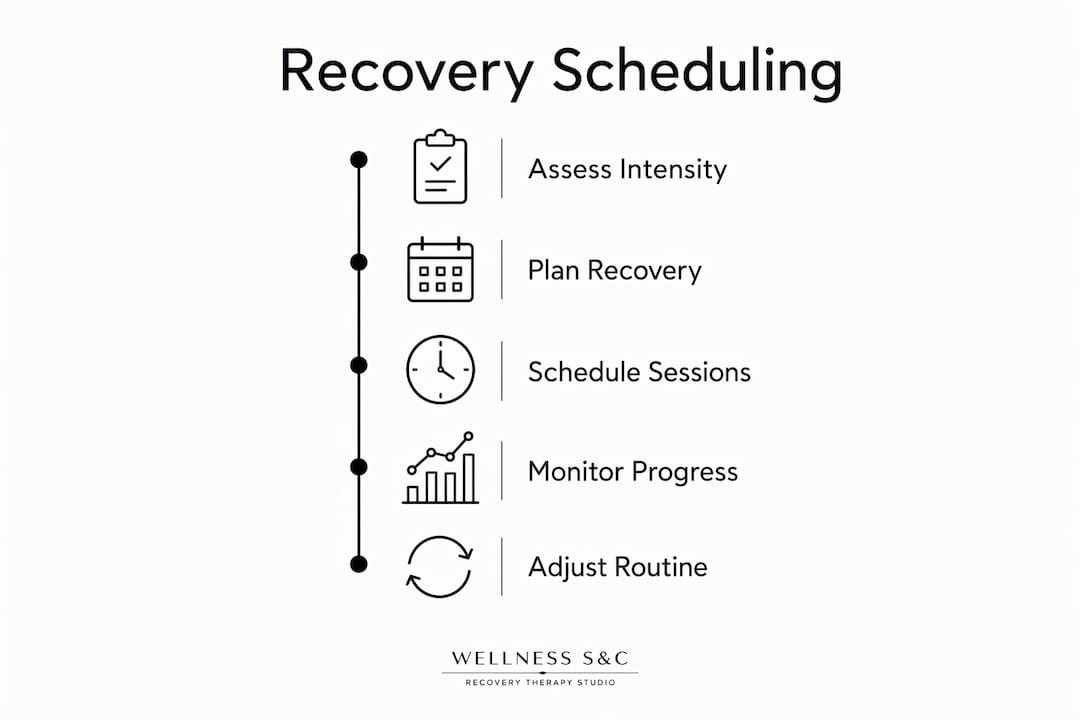
Practical scheduling comes down to four steps. Follow them in order and adjust based on what your body tells you.
Map your training week first. Write out every planned training session before you place recovery days. You cannot schedule rest intelligently without knowing where the hard work falls.
Insert recovery days between peak sessions. If you train legs hard on monday and again on thursday, wednesday is your recovery window for lower body work. Do not leave it blank. Fill it with a planned session type from the table above.
Watch for fatigue signals that require a recovery half-week. Tiered recovery strategies include recovery half-weeks lasting 3–4 days and full deload weeks. A recovery half-week lowers volume across all sessions without stopping training entirely. Use it when you notice performance dropping, sleep becoming disrupted, or motivation falling sharply.
Use objective metrics, not just soreness. A drop in countermovement jump height of more than 5% signals incomplete neuromuscular recovery. When that happens, reduce training volume by 20–30%, even if you feel only mildly sore. Soreness alone is a poor readiness indicator.
A practical sample week for an intermediate trainer might look like this: train monday, recover tuesday (active recovery or sauna), train wednesday and thursday, recover friday (mobility and cold plunge), train saturday, full rest sunday. That structure gives you five productive days and two intentional recovery windows without sacrificing momentum.
Lifestyle factors shape this schedule too. Sleep quality, nutrition, and daily stress all affect how fast you recover between sessions. Protein intake of 1.6–2.2 grams per kilogram of body weight supports muscle repair. If your sleep quality drops or life stress spikes, shift a training day to a recovery day rather than pushing through. The schedule serves you, not the other way around.
For a deeper look at science-backed recovery methods, Wellnesslasvegas has compiled research-grounded guidance specifically for athletes managing high training loads.
Most people make the same errors when planning recovery time. Recognizing them early saves weeks of stalled progress.
Treating recovery as reactive. Recovery is a proactive process, not a response to feeling broken. Waiting until you are exhausted to rest means you have already accumulated too much fatigue to recover quickly.
Relying only on muscle soreness. Soreness tells you about local muscle damage. It does not tell you about systemic fatigue, nervous system stress, or hormonal load. You can feel fine and still be under-recovered.
Skipping pre-scheduled recovery sessions when you feel good. Feeling good on a planned recovery day is not a reason to train instead. It means the recovery is working. Keep the appointment.
Ignoring soreness that extends beyond 72 hours. Consistent soreness past that window signals that training volume is too high or recovery practices are insufficient. Reduce volume and check sleep and nutrition before adding more training stress.
Failing to adjust for life outside the gym. A stressful work week, poor sleep, or travel all increase your recovery demand. The same training load that felt manageable last week may require an extra recovery day this week.
Pro Tip: Treat your recovery sessions as fixed appointments in your calendar, the same way you treat training sessions. Pre-scheduling recovery as a firm commitment is one of the clearest differences between people who make consistent progress and those who stall.
Scheduling recovery sessions as deliberate, pre-planned appointments based on training intensity, muscle recovery timelines, and objective fatigue markers is the most reliable way to build fitness without burning out.
| Point | Details |
|---|---|
| Recovery frequency by level | Beginners need 1–2 days weekly; high-frequency trainers need at least 2–3 structured recovery days. |
| Session length range | Focused sessions run 15–30 minutes; comprehensive routines including movement and breathing run 45–60 minutes. |
| Timing after hard training | Schedule recovery the day after your most demanding session, targeting the 48–72 hour muscle recovery window. |
| Use objective metrics | A countermovement jump drop of more than 5% signals incomplete recovery, even when soreness feels low. |
| Pre-schedule recovery | Booking recovery sessions in advance creates the consistency that produces long-term results. |
Working with clients in Las Vegas has shown me one pattern more than any other: the people who make the most consistent progress are not the ones who train the hardest. They are the ones who recover the most deliberately.
Las Vegas adds a layer most fitness guides ignore. The lifestyle here, late nights, high-stimulation environments, dry desert heat, and irregular schedules, increases your baseline recovery demand before you even step into a gym. That means a recovery plan that works for someone in a quieter city may not be enough here. You need to account for that extra stress load when planning your rest days.
What I have found actually works is treating recovery sessions exactly like training sessions. They get a time slot. They have a purpose. They do not get canceled because you feel fine. The 2–4 weekly recovery sessions that research points to as optimal are not a suggestion. They are the structure that makes everything else in your program function.
The other thing I tell every client: stop waiting for your body to beg for rest. By the time you feel truly exhausted, you have already lost a week of productive adaptation. Schedule the recovery first, then build your training around it.
— Argjenta
Wellnesslasvegas offers recovery sessions that fit directly into a structured weekly plan, whether you need passive restoration after a hard training block or targeted therapy between sessions.

Services like infrared sauna, cryotherapy, red light therapy, cold plunge, and dry float therapy are available in a private, professional environment built for results. Each session is designed to support circulation, reduce inflammation, and accelerate the recovery timeline your training demands. For athletes and busy professionals in Las Vegas, these modalities slot cleanly into the recovery days your schedule already needs. Book a session at Wellnesslasvegas and give your recovery the same attention you give your training.
Most people need 2–3 recovery days weekly. Beginners can start with 1–2 days, while high-frequency trainers should plan for at least 2–3 structured recovery sessions.
The best time is the day after your most intense training session. Large muscle groups need 48–72 hours to reach mid-point recovery, making that window ideal for a targeted recovery session.
Focused recovery sessions run 15–30 minutes. Comprehensive sessions that include movement, mobility, and breathwork typically run 45–60 minutes.
Active recovery uses low-intensity movement like cycling at 40–50% max heart rate to increase blood flow and clear lactate. Passive recovery uses modalities like infrared sauna, cold plunge, or dry float therapy that restore the body without physical output.
A countermovement jump height drop of more than 5% is a reliable signal of incomplete recovery. Soreness lasting beyond 72 hours also indicates that training volume or recovery practices need adjustment.

