- Infrared Sauna Las Vegas | Cold Plunge & Cryotherapy

Yes, UVB light produces vitamin D. It is the only light-based route that does. When UVB radiation hits your skin, it triggers a chain reaction that your body converts into the vitamin D your bones, immune system, and muscles depend on. Red light, infrared, and UVA do not do this. If you are relying on your infrared sauna or red light therapy sessions to maintain vitamin D status, you need a different plan.
UVB radiation in the 290–320 nm range penetrates the outer layer of your skin and converts 7-dehydrocholesterol into previtamin D3. Body heat then converts previtamin D3 into vitamin D3, which enters circulation and travels to the liver to become 25(OH)D. The kidneys then activate it into 1,25(OH)2D, the form your tissues actually use.
Wavelength precision matters more than most people realize. Research published in Scientific Reports found that wavelengths around 293–298 nm are significantly more efficient for vitamin D synthesis than broader UV spectra. A 305 nm LED, by comparison, converted more than 90% less 7-dehydrocholesterol in the same exposure time.
Your body also has a built-in safety valve. Excess UVB converts previtamin D3 into inactive compounds like lumisterol and tachysterol, which means sunburn, not vitamin D toxicity, is the real risk from overexposure.
Pro Tip: Exposing a larger body surface area generally produces bigger serum vitamin D changes than small areas alone. If you are trying to raise 25(OH)D through sun exposure, arms and legs matter.
Only UVB produces vitamin D. UVA, visible red light, and infrared do not trigger the 7-dehydrocholesterol conversion at all. Each band does something distinct:
A controlled pig-model study found that UV exposure and oral supplementation produce different tissue-level effects, including altered nitric oxide markers and cytokine responses. This helps explain why some people feel different after sun exposure versus taking a supplement, even when serum 25(OH)D looks similar.
Red light and infrared sessions at Wellnesslasvegas support recovery and circulation through real, evidence-backed mechanisms. They are not a substitute for UVB-driven vitamin D synthesis or supplementation.
Short, repeated exposures work better than one long session. Webb’s 2025 findings show that sub-erythemal doses raise serum 25(OH)D within 24 hours without triggering the catabolic 24,25(OH)2D3 pathway that large bolus exposures can activate.
Several factors change how much vitamin D your skin makes from the same amount of sun:
| Skin phototype | Relative exposure needed | Best Las Vegas timing |
|---|---|---|
| Type I–II (fair) | Shortest (few minutes, arms/legs) | Early morning or late afternoon |
| Type III–IV (medium) | Moderate (10–20 min, larger area) | Mid-morning before peak UV |
| Type V–VI (dark) | Longest (20–30+ min, large area) | Mid-morning, monitor carefully |
These are general examples only. Test serum 25(OH)D to confirm your actual status rather than relying on timing estimates.

The NIH Office of Dietary Supplements recommends SPF 15+ sunscreen to reduce skin cancer risk. Protect your face and neck, keep exposures sub-erythemal, and never aim for a burn.
Narrowband UVB devices used in clinical settings can raise vitamin D and are used to treat conditions like psoriasis. Commercial tanning beds are a different story. Most emit mostly UVA with inconsistent UVB output, and the cancer risk makes them a poor strategy for routine vitamin D production.
Device categories at a glance:
“Compared to broad-band ultraviolet light, a narrowband ultraviolet lamp is therapeutically more efficient and better tolerated. It avoids harmful and unnecessary UVB radiation wavelengths while supplying 25(OH)D.” — Medicine (Baltimore), narrowband UVB pilot study
If you are considering any artificial UVB source, ask about the peak wavelength, irradiance output, recommended dosing schedule, and whether clinician supervision is included. Unregulated devices can burn you at doses that still fail to raise 25(OH)D meaningfully.
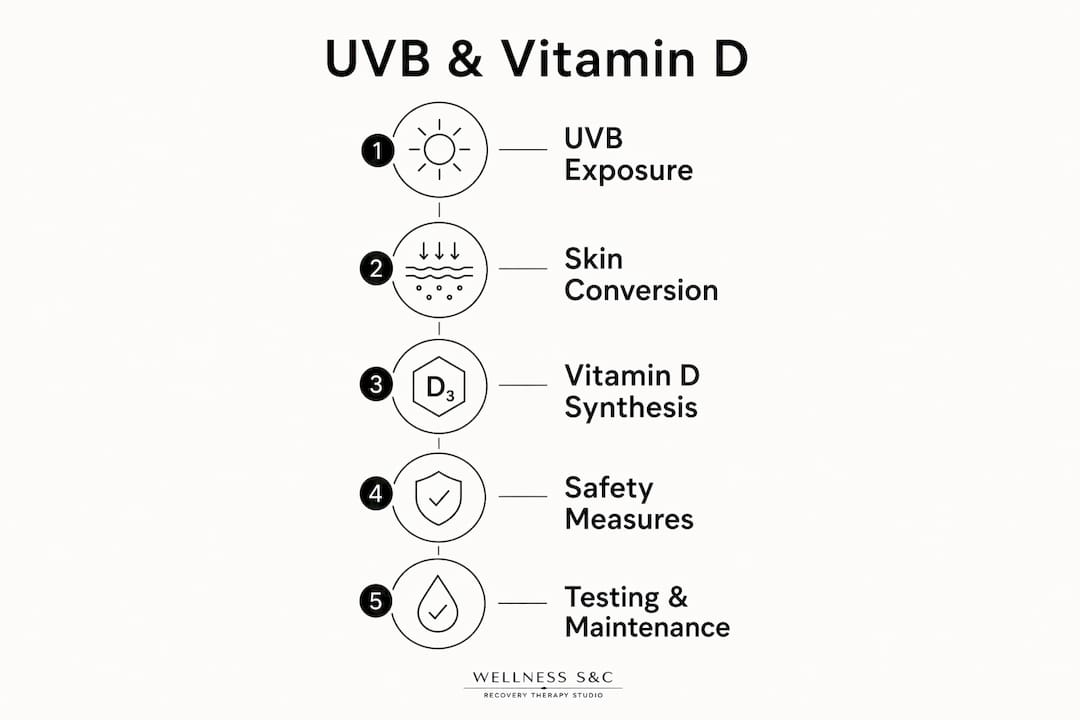
Test before you start. Whether you are planning a sun exposure protocol, considering a UVB lamp, or thinking about high-dose supplements, a baseline serum 25(OH)D result tells you where you actually stand. Clinicians commonly use a target range of 20–50 ng/mL, though optimal ranges vary by lab and population.
Daily low-dose supplementation tends to outperform large weekly bolus doses for maintaining stable levels. Webb’s research shows that small serum increases from regular low-dose UVR correlate with meaningful biochemical changes, including decreased PTH, even when the absolute 25(OH)D shift looks modest.
Special populations who should test more frequently and work with a clinician: older adults, people with darker skin, those with fat malabsorption conditions (Crohn’s, cystic fibrosis, post-bariatric surgery), and anyone on medications that affect vitamin D metabolism.
Do not self-prescribe high-dose vitamin D without a baseline lab result and clinician guidance. Toxicity from supplements, while rare, is real and avoidable.
Red light therapy and infrared sauna sessions at Wellnesslasvegas support circulation, tissue recovery, and mitochondrial signaling. They do not produce vitamin D. That distinction matters when you are building a complete wellness plan.
Think of it this way: UVB exposure or supplementation handles your vitamin D status. In-clinic therapies handle recovery, inflammation, and performance. Both have a role, and they work best together.
A practical sequence for Las Vegas clients:
For athletes, bone health is where these two strategies intersect most directly. Adequate vitamin D supports calcium absorption and bone density, while red light therapy and bone density research suggests additional non-vitamin-D mechanisms may support skeletal health through photobiomodulation. Wellnesslasvegas staff can help you sequence sessions around your training schedule.
UVB light is the only light-based route to vitamin D synthesis, and short repeated exposures raise 25(OH)D more safely than rare high-dose sessions.
| Point | Details |
|---|---|
| UVB is the only vitamin D light | Only the 290–320 nm UVB range converts 7-dehydrocholesterol into vitamin D3 in skin. |
| Little-and-often beats big doses | Sub-erythemal repeated exposures raise 25(OH)D without triggering catabolic pathways, per Webb (2025). |
| Red and infrared don’t make vitamin D | These wavelengths support recovery and circulation but do not trigger vitamin D synthesis. |
| Test before you dose | Measure serum 25(OH)D before starting high-dose supplements or a structured UVB protocol. |
| Wellnesslasvegas for recovery | Infrared sauna and red light therapy at Wellnesslasvegas complement vitamin D strategies but don’t replace them. |
Most articles about UVB and vitamin D treat the two strategies, sun exposure and in-clinic light therapy, as if they compete. They don’t. The mistake I see Las Vegas clients make is assuming that because they feel great after red light or infrared sessions, their vitamin D must be fine. That feeling is real, but it comes from nitric oxide release, improved circulation, and mitochondrial activity, not from vitamin D synthesis.
The more useful framing: your recovery therapies are doing exactly what they promise. Your vitamin D status is a separate variable that needs its own attention, especially if you spend most of your time indoors, drive to work, or train early morning before peak UV hours. Las Vegas sun is strong, but glass blocks UVB and most people are not getting the skin exposure they think they are.
Athletes especially should treat 25(OH)D as a trackable performance metric, not a background assumption. Bone health, muscle function, and immune resilience all have documented links to vitamin D status. Pair your recovery sessions with actual lab data, and you will have a plan that holds up.
If you are working on your vitamin D status and want recovery therapies that actually complement that plan, Wellnesslasvegas is where Las Vegas athletes and wellness-focused adults come to do both right. Infrared sauna sessions improve circulation and support deep tissue recovery. Red light therapy targets mitochondrial signaling and inflammation. Cryotherapy rounds out the recovery picture for high-output training weeks.
None of these replace UVB-driven vitamin D, and Wellnesslasvegas does not pretend they do. What the clinic offers is a private, professional environment where your recovery sessions are evidence-backed and your wellness plan is treated as a whole. Book your first session at Wellnesslasvegas and bring your 25(OH)D results. The team can help you build a protocol that covers both sides.
Yes. UVB radiation in the 290–320 nm range converts 7-dehydrocholesterol in your skin into previtamin D3, which the body then converts to vitamin D3. No other light wavelength triggers this pathway.
No. Red and near-infrared wavelengths support mitochondrial function, circulation, and tissue recovery, but they do not trigger vitamin D synthesis. UVB is the only light-based route.
There is no universal answer. Exposure time depends on your skin phototype, body surface area exposed, and time of day. Short, sub-erythemal sessions repeated regularly are safer and more effective than long infrequent exposures. Test serum 25(OH)D to confirm your actual status.
Some narrowband UVB devices can raise vitamin D, but home use without clinical guidance carries real burn and under-dosing risks. Consult a clinician before using any artificial UVB source.
Clinicians commonly use 20–50 ng/mL as a reference range, though optimal values vary by lab and individual. Test before starting any high-dose supplement or structured UVB protocol.

