- Infrared Sauna Las Vegas | Cold Plunge & Cryotherapy

A mild hyperbaric chamber is a soft-shell pressurized enclosure that delivers slightly elevated atmospheric pressure, typically around 1.3 ATA, to increase the amount of oxygen dissolved in your blood and tissues. For wellness and recovery purposes, it’s a reasonable option for healthy adults seeking non-invasive support for post-exercise recovery, sleep, or general vitality. It is not a substitute for clinical hyperbaric oxygen therapy (HBOT) when a medical condition requires it.
Quick answers:
The FDA has cleared soft-shell mild hyperbaric chambers for a narrow set of uses, most notably acute mountain sickness. Most wellness applications are off-label. That doesn’t make them unsafe or ineffective for general recovery — it means the burden of proof for specific medical claims is still being built.
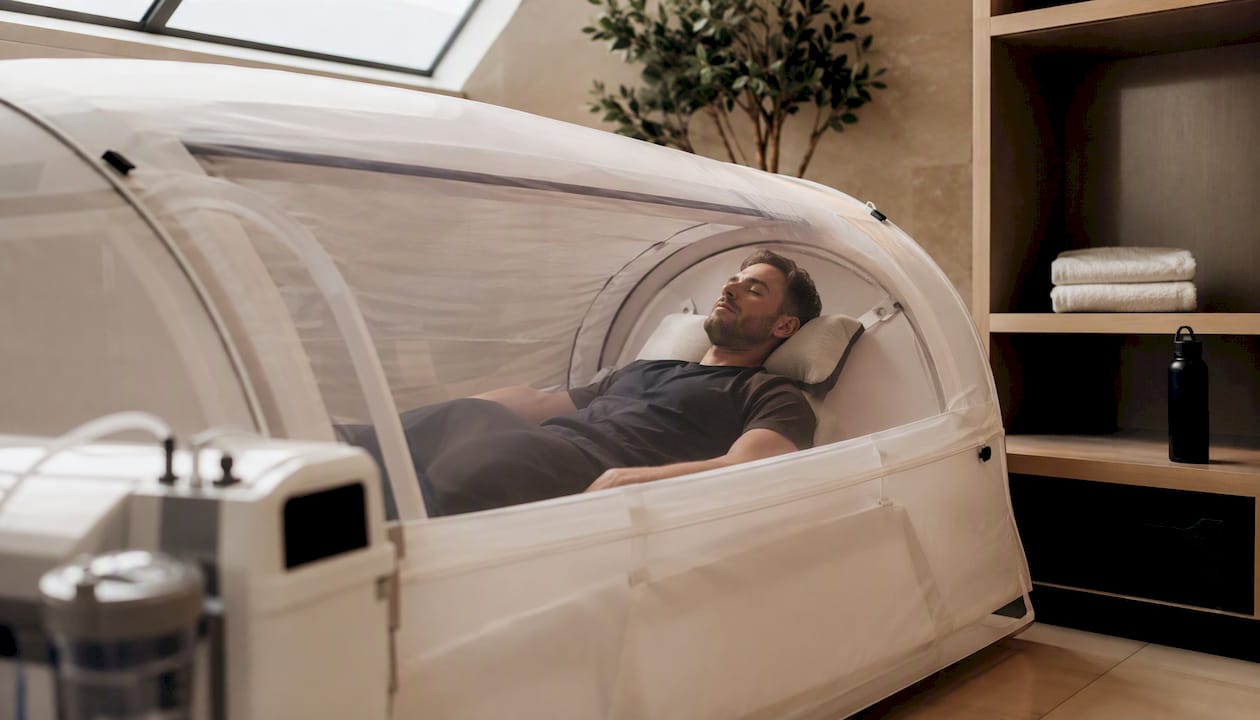
A mild hyperbaric chamber, often called a soft hyperbaric chamber or mHBOT chamber, is a flexible, inflatable enclosure that pressurizes to roughly 1.3 ATA using ambient air or air supplemented by an oxygen concentrator. You lie or sit inside while the increased pressure raises the partial pressure of oxygen in your lungs, pushing more dissolved oxygen into your plasma.
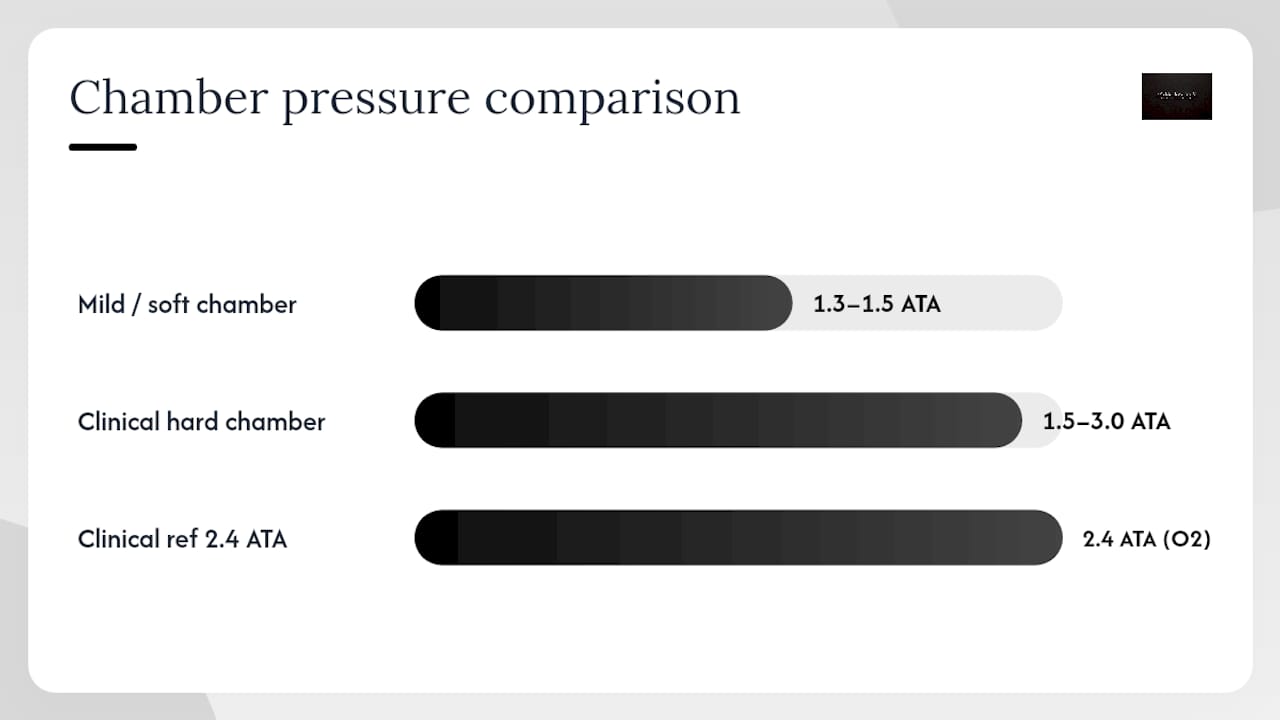
Clinical HBOT, by contrast, operates in rigid hard-shell chambers at pressures of 1.5–3.0 ATA with 100% medical-grade oxygen, always under physician supervision. The physiological difference is significant: the oxygen delivery at 2.4 ATA with pure O2 is orders of magnitude greater than what a soft chamber at 1.3 ATA with ambient air can achieve.
Here’s a direct comparison of the two approaches:
| Feature | Mild / Soft Chamber (mHBOT) | Clinical Hard Chamber (HBOT) |
|---|---|---|
| Pressure range | ~1.3–1.5 ATA | 1.5–3.0 ATA |
| Oxygen source | Ambient air or O2 concentrator | 100% medical-grade oxygen |
| Shell type | Soft, inflatable (portable) | Rigid, monoplace or multiplace |
| Evidence level | Limited; small trials, mixed results | Strong RCT evidence for approved indications |
| Common uses | Wellness, recovery, general vitality | Wound healing, CO poisoning, decompression sickness |
| Supervision | Wellness staff or self-supervised | Physician-supervised |
| FDA status | Cleared for acute mountain sickness; most wellness uses are off-label | Approved for multiple FDA-cleared medical indications |
According to consumer and technical guides, home soft-shell units are typically marketed as wellness devices, and buyers should understand that the FDA clearance scope is narrow. That’s an important framing point before you spend money on a unit or book sessions.
The core mechanism is straightforward. Under normal atmospheric pressure (1.0 ATA), most oxygen in your blood travels bound to hemoglobin. Hemoglobin is already close to fully saturated in healthy people, so breathing more oxygen at normal pressure doesn’t add much. Pressure changes that equation.
When you increase ambient pressure, more oxygen dissolves directly into your blood plasma, independent of hemoglobin. That dissolved oxygen can reach tissues that compressed or damaged blood vessels might otherwise struggle to supply.
Here’s how the key variables interact:
Understanding oxygen’s role in tissue healing helps put these numbers in context — the body uses oxygen not just for energy but for collagen synthesis, immune signaling, and cellular repair.
Pro Tip: If you’re booking sessions at a wellness center, ask whether the chamber uses an oxygen concentrator or ambient air. A concentrator-supplemented session at 1.3 ATA delivers meaningfully more dissolved oxygen than ambient air alone at the same pressure — it’s worth knowing what you’re paying for.
Some small studies and physiological rationale support modest benefits from mild hyperbaric exposure. The evidence is real but limited, and it’s weaker than the evidence base for clinical HBOT treating approved medical conditions. Here’s where things stand by benefit category.
This methodological wrinkle, documented in earlier PubMed trial records, is one reason the evidence picture is complicated. A 1.3 ATA session isn’t a placebo.
| Claimed Benefit | Evidence Level | Notes |
|---|---|---|
| Post-exercise recovery | Moderate | Physiological rationale is solid; small trials show reduced soreness and faster return to performance |
| Immune / NK cell activity | Limited but measurable | A 2023 PMC study found enhanced natural killer cell activity in healthy volunteers after mild hyperbaric exposure |
| Cognitive support | Limited | Small studies suggest possible benefit; no large RCTs confirm this for wellness populations |
| Sleep quality | Limited | Anecdotal reports are common; controlled trial data is sparse |
| Wound healing | Contradictory / insufficient at mild pressures | Clinical wound healing requires 2.0+ ATA with medical oxygen; mild chambers are not indicated |
| Inflammation reduction | Moderate (physiological) | Dissolved oxygen can modulate inflammatory signaling; effect size at 1.3 ATA is smaller than clinical HBOT |
Systematic reviews indexed on PubMed consistently note that low-pressure protocols show variable outcomes across trials, and that higher-ATA clinical HBOT has a more consistent positive evidence base for medical indications. That’s not a reason to dismiss mild HBOT for wellness — it’s a reason to calibrate your expectations.
The NK cell finding from the 2023 PMC study is worth highlighting because it demonstrates that measurable immune changes can occur at mild pressures, even in healthy volunteers with no medical condition. Small sample, but a real signal.
For most healthy adults, mild hyperbaric therapy has a favorable safety profile compared to clinical HBOT. The lower pressures and ambient-air oxygen sources reduce the risk of oxygen toxicity, which is the primary serious risk in full clinical chambers.
Populations who need medical clearance before starting:
Red flags — stop the session and seek medical attention if you experience:
The Mayo Clinic’s clinical HBOT overview notes that even at clinical pressures, serious adverse events are rare when proper screening is in place. At mild pressures, the risk profile is lower still, but screening matters. If you have any chronic cardiopulmonary or ear condition, talk to your primary care provider before your first session.
This article is general wellness information, not medical advice. Confirm your suitability for hyperbaric therapy with a qualified healthcare provider.
The research base for mild hyperbaric therapy is growing but still thin compared to clinical HBOT. Here are the most relevant studies and what they contribute.
| Study / Source | Design | Key Finding | Limitation |
|---|---|---|---|
| PMC 2023 — NK cell activity | Small RCT, healthy young women | Mild hyperbaric exposure enhanced peripheral natural killer cell activity | Small sample; healthy volunteers only |
| PubMed systematic review | Systematic review of low-pressure protocols | Mixed results; evidence quality varies widely across trials | Heterogeneous protocols make comparison difficult |
| PubMed — sham arm analysis | Trial-level review | 1.3 ATA used as sham showed measurable improvements, complicating interpretation | Raises questions about what “placebo” means at mild pressure |
| Mayo Clinic HBOT overview | Authoritative clinical summary | Clinical HBOT at 2.0+ ATA has strong evidence for 14+ approved indications | Focuses on clinical HBOT, not mild wellness chambers |
The overall trend in the literature: small trials with physiologically plausible findings, inconsistent protocols, and a clear need for larger randomized controlled trials. That’s not a dismissal of mild HBOT — it’s an honest read of where the science stands. For oxygen-based recovery approaches, the physiological rationale is strong even where the trial evidence is still catching up.
Mild hyperbaric chambers produce real physiological effects at 1.3 ATA, but their evidence base for wellness benefits is still developing, and they are not interchangeable with clinical HBOT for medical indications.
| Point | Details |
|---|---|
| Pressure and oxygen delivery | Soft chambers at ~1.3 ATA deliver a modest dissolved oxygen increase; clinical HBOT at 2.0+ ATA delivers far greater amounts. |
| Evidence strength | Small studies show measurable immune and recovery signals; systematic reviews find mixed results across low-pressure protocols. |
| Safety and screening | Favorable safety profile for healthy adults; ear barotrauma is the most common issue; medical clearance is needed for high-risk groups. |
| Cost reality | Wellness-center sessions typically cost tens to low hundreds of dollars; home units vary widely in price, with break-even depending on usage patterns. |
| Las Vegas option | Wellnesslasvegas offers oxygen-based and complementary recovery therapies in Las Vegas for athletes and wellness-focused adults seeking non-invasive recovery support. |
Most people who ask about mild hyperbaric therapy aren’t looking for a medical treatment. They’re looking for a recovery edge — something that helps them feel better after hard training, sleep more deeply, or manage the cumulative stress of a demanding schedule. That’s a legitimate goal, and mild HBOT can be a reasonable part of that picture.
What often gets missed in the marketing conversation is that mild hyperbaric therapy works best as one layer in a multi-modal recovery protocol, not as a standalone solution. The physiological effects at 1.3 ATA are real but modest. Pair them with therapies that address circulation, inflammation, and nervous system recovery — infrared sauna, cold plunge, red light therapy — and the cumulative effect tends to be more meaningful than any single modality alone. Multi-modal therapy integration is where the real recovery gains tend to show up.
There’s also a practical point that wellness marketing tends to skip: the quality of the facility and the consistency of your protocol matter more than which specific chamber brand you use. A well-run clinic with proper screening, maintained equipment, and trained staff will produce better outcomes than a premium home unit used sporadically without guidance.
For Las Vegas residents specifically, the access to recovery-focused studios means you don’t need to invest $10,000+ in a home unit to explore whether mild hyperbaric therapy works for your body. Start with a clinic protocol, track how you feel across 10–15 sessions, and then decide whether home ownership makes financial sense for your usage pattern.
If you’re drawn to the oxygen and recovery benefits of mild hyperbaric therapy, Wellnesslasvegas offers a range of therapies that target the same recovery goals through different mechanisms — and they’re all available in one Las Vegas facility.
Steam oxygen therapy delivers humidified, oxygen-enriched air in a relaxing pod environment, supporting circulation and respiratory wellness without the pressure component. Infrared sauna sessions drive deep tissue warming that accelerates muscle recovery and promotes detoxification. Cryotherapy and cold plunge reduce acute inflammation and reset the nervous system after intense exertion. Red light therapy supports cellular energy production and tissue repair at a wavelength the body responds to directly.
Each of these therapies addresses a different piece of the recovery equation. Used together, they cover circulation, oxygenation, inflammation, and cellular repair in a way that no single modality can match on its own.
Ready to build a recovery protocol that actually fits your schedule and goals? Book a session at Wellnesslasvegas and talk to the team about which combination of therapies makes the most sense for where you are right now.
| Source | What it covers | Why it’s useful |
|---|---|---|
| PMC — NK cell study (2023) | Immune effects of mild hyperbaric exposure in healthy women | Primary trial data showing measurable biological effects at mild pressure |
| PubMed — systematic review | Mixed results across low-pressure HBOT protocols | Honest summary of evidence quality and variability |
| PubMed — sham arm analysis | Trial methodology and 1.3 ATA sham debate | Explains why mild pressure isn’t truly inert as a control |
| Mayo Clinic — HBOT overview | Clinical HBOT indications, safety, and procedure | Authoritative contrast between clinical and wellness-grade chambers |
| Baricboost — mild chamber guide | FDA clearance scope, 1.3 ATA specs, buyer notes | Practical consumer-facing detail on home unit considerations |
| Regenerated — soft chamber analysis | Dissolved oxygen comparisons, use cases | Useful for understanding relative physiological effects |
| Hyperbaric Pro — FAQ | Session length, ATA values, home-use safety | Operational detail for session planning |
| Baricboost — chamber bed guide | Home unit pricing, sizing, comfort | Concrete price ranges for purchase vs clinic comparison |
For local implementation and booking in Las Vegas, the oxygen therapy recovery guide at Wellnesslasvegas covers practical session protocols and what to expect from oxygen-based therapies in a clinical wellness setting.
Small studies show measurable physiological effects, including enhanced immune cell activity and modest recovery support, but evidence for specific wellness claims remains limited and mixed across systematic reviews.
Wellness-center sessions typically run $75–$150 per session in the U.S. Home soft-shell chambers range from roughly $4,000 to $23,000 depending on model, with an optional oxygen concentrator adding $500–$2,000.
A mild chamber uses a soft inflatable shell at ~1.3 ATA with ambient or concentrator-supplemented air; a clinical chamber is a rigid hard shell operating at 1.5–3.0 ATA with 100% medical oxygen under physician supervision, with a much stronger evidence base for medical indications.
The most common side effect is ear barotrauma from pressure changes. At mild pressures, serious risks are rare, but people with ear infections, certain lung conditions, uncontrolled hypertension, or pregnancy should get medical clearance before starting sessions.

